Looking Back at the 2012 Real Food Summit
In 2012 Sean Croxton launched an online health conference called The Real Food Summit. This was the summit's official website.
The new owners of the domain wanted to keep the summit's message visible on the web.
Content is mostly from the site's 2012 archived pages as well as from other outside sources.
The Real Food Summit: 27 Free (Online) Presentations by Top Nutrition & Health Experts
BY Chris Kresser
Sean Croxton is about to launch another online health conference he’s calling The Real Food Summit. If you watched his Paleo Summit a few months back, you know that Sean’s an excellent interviewer who produces great events.
This summit isn’t just for the Paleo crowd, though. This is for anyone interested in nutrient-dense, whole foods – a.k.a. “real food”.
Here are a few of the speakers at the Summit:
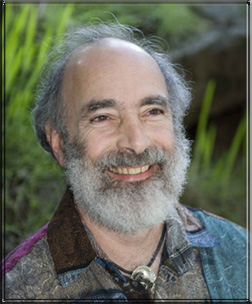
- Joel Salatin leads off the summit, as he defines what real cows, real chickens, and real pigs really are
- Yours truly discussing the importance of fish and seafood in the Real Food diet
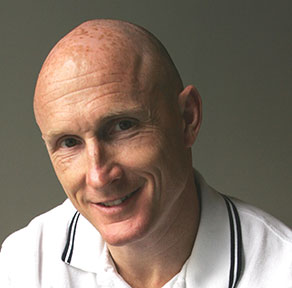
- Paul Chek discusses how eating whole foods impacts your mind, body, and soul
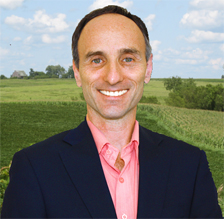
- Jeffrey Smith dishes the real dirt on genetically modified foods
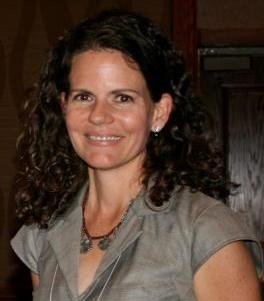
- Mark McAfee shows you how raw milk can heal a broken immune system
- Chris Masterjohn shares the nutritional wisdom of Weston A. Price
All told, there are 27 video presentations that you’ll be able to watch for free during this 9-day event.
The summit kicks off Sunday, July 8th, but if you pre-register Sean is offering a bonus: a presentation by real food farmer and activist Joel Salatin called Real Food Defined.
~~~
Update: Let me just say that I am a fan of Sean Croxton. I've followed him since 2012 when my daughter suggested I check out his online health conference called The Real Food Summit. During these trying times which started in 2016 when Trump was elected president to 2020 with the Covid-19 pandemic, the Black Lives Matter movement exploding across the country, to the NYC shut down during the Covid 19 surge this past Spring to the Fall with the 2020 elections, Sean's podcasts have inspired me and kept me sane. With the gradual reopening of NYC, where I live, my feeling of relief was cut short to learn that a childhood friend was taken to a hospital when he could not breathe, but has been there for over a week. He lives in Louisiana, working as a Louisiana maritime lawyer for a maritime injury practice and learning the ropes in hopes of opening his own shop. He's very proud of his job and wants to share the url with everyone he meets. But now I'm just hoping that he makes it out of there. I really need a distraction right now. Fortunately my daughter also listens to Sean's podcasts so we spent a little time discussing that day's episode with Wayne Dyer ( who gave a timely talk about leadership, government, and who the true leaders are. Thanks Sean for hosting these podcasts. I always listen in.
~~~
Real Food Summit – FREE online series
Posted on July 10, 2012 by Carolyn Biggerstaff

In case you haven’t heard about it, there’s an excellent FREE seminar series now on the Internet—Real Food Summit. There are three seminars available each day through July 16. The Summit began July 8, but it’s not too late to register for the remaining seminars. I was able to listen to two of Sunday’s sessions (Chris Kresser, The Importance of Fish and Seafood in the Real Diet, and David Getoff, The Historical Truth about Raw Fruit Consumption) and was very impressed with the amount of information given. I’ve also listened Jeffrey Smith’s GMO presentation, which was full of good information about the dangers of GMOs and how to avoid them to improve your health. Monday’s session with Paul Chek on Science in Agriculture was very good about how important soil quality is to the food we eat.
Each day’s three seminars are only available for 24 hours. Today’s will be replaced at midnight Pacific time, so you still have time to listen to them today. You can ask questions about the topics in the comments. There are Facebook chats with some of the speakers for more questions and answers.
Seminars for today, July 10, 2012:
Chris Masterjohn on Weston Price on Primitive Wisdom (Part 1 of 2)
the Caltons on Micronutrient Deficiency and Obesity
Aaron Lucich on We Are What We Eat [so true!]
Go here to register for the FREE seminars
The whole package will be available for purchase after the end of the Summit.
Let me know what you think of the series!


Food.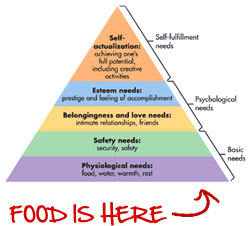
A smart guy named Maslow called it one of the most basic of all human needs, right along with air, water, and sleep.
But in less than a half-century, food has swiftly gone from homemade and simple to one of the most confusing, complicated, and divisive topics under the sun.
This morning I searched “diet books” on Amazon and it came up with 65,663 results!
My goodness…
I can only imagine what it must be like for the average person to go online simply looking for basic diet information. It must be a nightmare!!!

I can speak from experience on this one. I’ve spent the past decade studying nutrition and health. Half of that time I was just certain that I had found the perfect human diet. The other half I was confused out of mind.
You name it, I’ve tried it…
USDA Food Pyramid. South Beach. Sugar Busters. Atkins. Vegan. Vegetarian. Metabolic Typing. Low-Calorie. Low-Carb. High-Carb. Low-Fat. High-Fat. No-Fat.
I can keep going!!!
Then, a little over a year ago I had an epiphany.
First off, YOU are not interested in spending a decade of your life reading diet books and such. You’ve got better things to do with your time and sanity.
Next, if you turn back the clock to the early-1900s, you’ll find some interesting things about the people of that time…
#2.They DID NOT die of modern diseases like diabetes, cancer, and heart disease.
#3. They were NOT jumping on and off of different diets.
#4. They were NOT having silly blogger wars about whose diet is the best diet.
Our ancestors of not that long ago were healthier and more robust and productive than we twenty-first-century folks have ever been.
Did they need 65,663 diet books to do it?
Nope, they kept things simple…they Just Ate Real Food.
These days, due to savvy marketing, media scare tactics, and a blogosphere that seems to confuse you more than help you, most of us don’t know what Real Food really is.
So I called out to over 30 of my friends to come together for an online event, unlike any other, called The Real Food Summit.
Upgrade and Bring the Real Food Summit Home with You!
The Real Food Summit Take-Home Package is 9 days (over 20 hours!) of video/audio presentations from real farmers, doctors, researchers, and authors that will give you all of the information you need to end the diet madness once and for all.
You’ll be able to download and watch the video slideshow presentations right on your computer or iPad, listen to the audio versions on your mp3 player or smart phone, or read the over-300 pages of transcripts as often as your health desires.
When I put this event together, I wanted to make sure that our presenters answered as many of your questions as humanly possible!

Questions like…
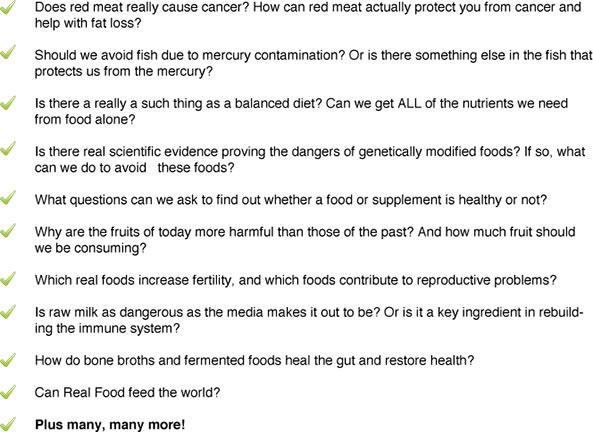
Your Real Food Summit
Take-Home Package will include…

Click here for details and refund information

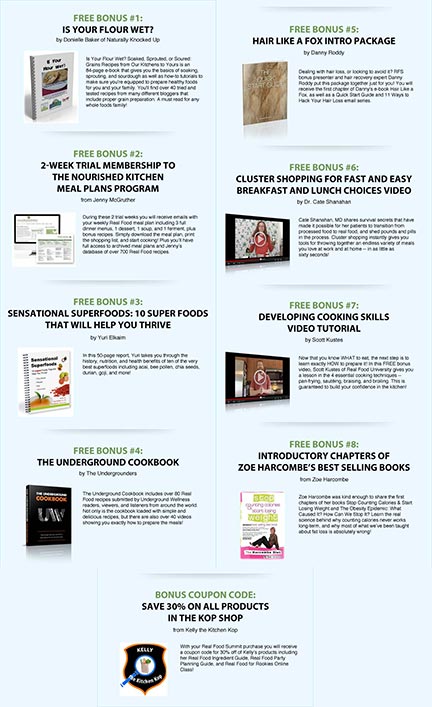
This package is worth at least $400 — and that’s NOT including the value of all of the bonus goodies!
Today, I am offering it to you at a
SUPER LOW PRICE of just $99!
Only $99!
As always, there is no catch! Yeah, I like to make a few bucks. (Don’t we all?) But my chief aim is to get this health-saving information out to the public at the most affordable price possible.


















Only $99!
Real Food Defined
Presenter: Joel Salatin
Website: www.polyfacefarms.com
Live Q&A Session: Monday, July 9th, 2012 at 5pm PT/8pm ET on UW Radio
In This Presentation…
* The role of the herbivore in nature
* Why traditional diets were centered around herbivores and/or seafood
* The nutrition consequences of feeding an animal an improper diet
* How to navigate confusing food labels and categories
* The obstacles in place to keep real food out of the commercial supermarket
* The impact of opting out of the modern food system
* Is real food elitist?
* Can real food feed the world?
~~~~~~~~~~~~~~~~
COMMENTS
In the download video/slideshow interview with Joel Salatin – the “Importance of Herbivores” slide… - Can be grown without tillage. Not pillage.
Thank you so much for this! I’m looking forward to viewing as many of the videos/slideshows as I can during the summit! Also, thank you for making this a free event – this is just wonderful information.
-
http://twitter.com/ugwellness Sean Croxton
Thanks, Lisa. That was fixed this week and has been corrected in the above video.
-
Lisa Mazzuca
I’ve written to the mayor and council of my town in Beachwood, NJ to try to get them to change the ordinance that makes owning any backyard chickens illegal where I live. The dialogue has begun and the mayor suggested I make a formal application to the land use board for individual permission (since I seem to have done my homework about it, I guess). I’m looking forward to adding chickens to my yard, gardening and composting I’ve been enjoying in Beachwood and hopefully my application will be approved. What Joel talks about in the video above is great information I can use to support my argument. Thank you again!
-
http://twitter.com/ugwellness Sean Croxton
Good luck, Lisa!!!
-
-
-
http://twitter.com/ugwellness Sean Croxton
OOOOOOOOOHHHHH YEEEEEEEEEEAH!!!!!!!!!!!!
Time to get our learn on, peeps!
-
Clark Danger
AWESOME sound, Sean. Looks like you put TONS of work into this. Appreciate that bro, for real. Thanks man.
-
http://twitter.com/ugwellness Sean Croxton
Thanks, Clark. I hired an engineer to make these presentations sound good. Much better sound quality than the #paleo summit.
-
!!BrandiLynn!!
Whoot! Thanks for this – question backtracking about “key words” for pork (the conversation turned to supermarket addiction). Looking for beef to be grass finished, poultry to be pastured – pork ?
Thanks!
-
http://twitter.com/ugwellness Sean Croxton
I’ll ask Joel tomorrow on the radio show. Thanks for bringing that up!
-
http://www.facebook.com/cassie.bond.3557 Cassie Bond
Sean, this podcast works for 5 minutes then says “an error occured please try late”
Just letting you know
-
http://twitter.com/ugwellness Sean Croxton
Hmmmm….not sure why that would happen. Seems to be working fine for everyone else. Is it working now?
-
Wortmann Marcelle
I’m going to find out more about our farmers market in town once a week…..I have never as I can’t really understand nor speak German…..but after listing to Room 1….I cannot not!!!!
-
http://www.facebook.com/profile.php?id=100000135970236 Suzanne Dupont Healy
Great presentation! Got me searching for local farms in my area. Thanks for the info.
-
http://twitter.com/ugwellness Sean Croxton
Thanks for watching, Suzanne! Glad you enjoyed Joel’s talk. I hope you find some organic farms in your area!
-
http://www.facebook.com/people/Che-Patton/100000287946225 Che Patton
So Beautiful, actually made me cry as my heart and soul crave a community change on such this level, and I see that it is my responsibility to do my part. I love supporting our local farms here in North Carolina, I love driving up to the dairy farm and to say hello to the cows, and see the happy babies walking along side them, and this symbiotic relationship you spoke about really put the nail on the head. I feel connected to the whole of the Earth, Nature, and Life with this way of life. Thank You SO Much for all you do and share.
 ~ Love Che
 -
http://www.facebook.com/people/Che-Patton/100000287946225 Che Patton
In regards to eating meat, it was brought up to me that when an animal is killed they have an adrenaline rush/release.. does that effect the health of the meat and is there Truth in this, and does that effect us when we consume it?
-
http://twitter.com/ugwellness Sean Croxton
Thanks for the question, Che. I’ll be sure to ask Joel during tomorrow’s LIVE Q&A session on BlogTalk Radio.
-
Kim Brooks
Excellent!! I looked into Polyface after this presentation but unfortunately I think because of where I live/work I’m out of the zone. Definitely going to look more into farms. I was discouraged because I thought that I couldn’t get portions for one person unless I went to a farmers market, but now I’m re-energized on this effort.
-
Andre
There is a concept of a community food co-op where if you get enough friends and neighbors together you can make a large reoccuring purchase from a farm. It is talked about in The Omnivores Dilemma….EVERYONE SHOULD READ THIS BOOK!
-
http://twitter.com/endreffy Ildiko Endreffy Ph.D
Thank you for your informative talk.
-
http://twitter.com/ugwellnessSean Croxton
No prob! Thanks for attending. Hope to see you around here for the next 9 days!
-
http://primaltoad.com/ Todd Dosenberry
Such an awesome presentation. Thank you for doing this Sean. This information must get to the masses as soon as possible. I took lots of notes and was kind of shocked by some things!
Always love the continuing education that is not from your standard classroom.
-
http://twitter.com/ugwellness Sean Croxton
My pleasure, Todd. Thanks for attending and promoting!
-
Andrea Merrigan<
Loved the presentation. I wish I could get quality grass fed beef for $5/lb. I am paying $9/lb here in AL
 but I still budget high priced quality foods because it is important to our family! Not eating out saves us tons of money that we can use to purchase wonderful meats and produce. Thanks for the presentation!
-
http://twitter.com/ugwellness Sean Croxton
Good job, Andrea. Way to cut back on eating out. If more people did that, they’d be able to afford real food. Have you ever been to http://www.eatwild.com? You may find a local farmer who sells ground beef for cheaper.
-
Sally
Very informative. I appreciate info re: new avenues for getting better connected with real food. This series does not disappoint! Thank you.
-
Rayleen
Great show…. I’m so fortunate to have a fabulous co-op, growers/farmer’s markets, and more locals who are demanding clean honest real food.
-
Karen Davis
Thanks for a great presentation. I’ve been on a Real Food quest for almost a year now, and it’s amazing what sources of Real Food you find in your own community when you start looking and researching. I’ve been able to go from a completely SAD (Standard American Diet) lifestyle to now eating pastured beef, pork, chicken, turkey, raw milk, and locally grown organic fruits and vegetables in 6-9 months. I hope this movement keeps growing at the same rate it seems to be growing now. Thanks to Joel for being a loud voice in the Real Food movement!!
-
http://www.facebook.com/EnviroAsh Ashley White
Awesome as always Sean! Your podcasts boost my motivation to JERF. The question of local vs. organic always goes through my mind. I live in Ontario, Canada and it is very hard to find good farms here. Which is most beneficial, eating locally (non-organic/grass fed) or organic foods that may be shipped here from across the world. I typically see these words, antibiotic free, organic, local. I find it hard to trust a label when I haven’t seen the farm with my own eyes. Do you have any sources for Canadian farms?
-
http://www.facebook.com/profile.php?id=507325694 Collecia Sherman
Grass finished beef was mentioned often in the interview. Are there differences between grass finished and 100% grass fed as far as health benefits/risks?
-
Noel McGran
Most grass fed beef is “finished” on grains. That means that they graze on grass
for most of their lives, but are fed grains during the last few months
to fatten them up (and we wonder why whole wheat makes us fat). Grass
finished beef cattle are never fed grains.
-
Mimi Powers1
How does getting our free-range, pastured chickens and beef from a Virginia or Pennsylvania farm affect our quality while being transported by truck cross-country 3,000 miles? In other words, if I live in southern California should I buy my meat directly only from California farms?
-
Christine
That would definately be the idea. Local is best. Leave the chickens and beef in Virginia for the folks there. I don’t believe Polyface farm will ship meat farther than 100 or 200 miles. Too much fuel consumption. If we all eat from our own local communities everyone will have the freshest, in season foods and our local farmers will be able to stay in business.
-
Mrs. Michael Buron
The whole family is watching, listening, & learning! THank you for putting this on!!!
-
Diaz Yvonne
People often recommend that we find a local farmer and buy large amounts of beef and other meats and store them in a second freezer. How healthy is this ? I remember reading in Dr. Shwarzbein’s book that we should eat meat that is as fresh as possible. Your thoughts?
-
Bathed_in_electricity
Sean Croxton is just trying to tell you good things about your bad habits. Eat more fruits and vegetables. There, I just saved you tons of time and money. These Primal dieters are just selling a repackaged version of the Standard American Diet. Meat is not a health food. Our bodies aren’t even designed to handle the digestion ( putrification ) of meat. We are, by design frugivores. You’ll know it when you try it.
-
Matteo
Sean, thanks so much for organizing this Real Food Summit. I have listened to all three seminars and the amount of information I have listened to and taken notes on is staggering; and it’s only the first day! Kudos to you and your team for helping to educate the public about the importance of a healthy lifestyle.
Much health and success.
-
Elaine
Great!! love this! Thank you for putting it together, Sean. Will the 9 days be available to purchase after these 9 days? How do I get to “UW radio”?
-
http://twitter.com/JasonBosleySmth Jason Bosley-Smith
Elaine – Yes, the presentations along with tons of bonus materials including 7 additional audio presentations (including one with me on Nutrient Pairing) will be available for purchase. You can get to UW radio in the link above on the right hand side or search for “Underground Wellness” on iTunes and subscribe there. Great to connect with you!
-
http://www.facebook.com/profile.php?id=1040203371 Ayana Sabree
Regarding the different types of eggs for consumption; I am in a situation where I buy pasture perfect eggs, but there aren’t enough to sustain me and my family. In lieu of not having the pasture perfect eggs, would it be acceptable to buy organic eggs or vegetarian fed eggs?
-
http://profiles.google.com/aaluther Anne Luther
Absolutely awesome presentations. Looking forward to day 2.
-
Maureencmeunier
I’m confused. Why grass finished instead of grass fed beef? I thought grass fed was the preferred choice.
Thank you
-
Noel McGran
Most grass fed beef is “finished” on grains. That means that they graze on grass for most of their lives, but are fed grains during the last few months to fatten them up (and we wonder why whole wheat makes us fat). Grass finished beef cattle are never fed grains.
-
http://www.facebook.com/losefatfast Wess Murray
Awesome Job, Sean!
-
Skuzan
Great presentations and presenters! Thanks for sharing all of this valuable information with us. Can’t wait for more!
-
joymassa
I just listened to Joel Salatin and am full of gratitude for all the organizing/producing/commitment necessary for me to have been able to do so! Thank you Sean Croxton! Today was the first day I knew you existed & here (thank you to Nourished Kitchen Jenny), I am fully immersed in one of your projects! (And I learned you’re local to me – fellow San Diegan!) I’m looking forward to all the presentations & days ahead!
-
Orla Keating<
Whenever I watch anything with Joel I always imagine myself owning and running a farm and how I’d go about it. My uncle has a farm so maybe one day but I doubt it, and in Ireland we’re already some of the way there cattle and sheep are all pasture raised. I’d also have some goats because I adore goats cheese!
-
Kerry
Where do I find grain finished steak up here in Canada? Or anywhere for that fact…
-
Eatfood123
do you mean grass fed? If so, what part of Canada are you in?
-
http://www.grassfedmomma.blogspot.com grassfedmomma
I love Joel and You Sean! Great Summit as they all are! My question is how do we get on a mailing list for when his virtual market idea becomes a reality? One day I will visit Polyface farm but for now, I love to hear all about what real sustainable farming is all about..
-
Jsehler
Thank you Mr. Salatin! Speaking about your relationship with your pigs,
how you gave them a job in composting, made me so happy! Even the
“lowly” pigs and chickens have a purpose in their life besides being
fattened for slaughtered. That vision helps me return to a level of
understanding and acceptance with regard to slaughter of farm animals
that I had lost. Can I come and work with you? What a great place to
live. Thank you for the great seminar Sean. -
http://twitter.com/ugwellness
Thanks for posting all of these awesome questions. Be sure to catch UW Radio tomorrow (Monday) at 5pm PT/8pm ET for a LIVE Q&A with Joel. You can tune in by internet here – real-food-summit-live-qa–joel-salatin-and-paul-chek – or listen by phone by dialing 347-237-508. Dial this number to get on the air with Joel!
The show will also be archived on iTunes and BlogTalk Radio.
-
Pamela"Wow, Joel was amazing! "
-
http://mtfw.net/ Danielle
Very informative sessions. I could listen to Joe Salatin talk forever. I want my husband to listen to all or part of the other two sessions. I think it would really impact him.
-
http://mtfw.net/Danielle
Joel….i missed the “L”
-
Julied717
I have read all of Mr. Salatin’s books, and try to follow the preaching. I am doing container gardening, buy pastured eggs and chickens, support local farmers, put by food, ferment foods, and eat clean as possible….I am afraid for my children…How can I be more involved in solving our food source dilemma? MERSA in pork? Good God, we are doing ourselves in. where to run, where to hide? Losing it in OHIO. I need someone to show me the way.
~~~~~~~~~~~~~~~~~~~~~~~~~